
Understanding Large-Scale Testing Requirements
In the modern software development landscape, large organizations face unique challenges regarding speed, reliability, and security. As teams grow and applications become more complex, the limitations of standard or mid-tier subscription models often become apparent. This is where organizations need to look closely at Test.com pricing enterprise plans to ensure their testing infrastructure can handle massive, concurrent execution demands.
Enterprise solutions are designed not just for higher volume, but for deep integration into complex DevOps pipelines. They offer the necessary control to manage global teams, enforce strict security protocols, and gain granular visibility into test performance across diverse environments. When choosing a platform at this scale, the goal shifts from simple feature access to achieving seamless orchestration and reducing the total cost of ownership. Understanding how these plans differ from smaller tiers helps stakeholders align their technical requirements with long-term business objectives, ensuring that the chosen testing partner can support innovation rather than becoming a bottleneck. Choosing the right path requires evaluating current usage patterns against future growth projections to maximize the value of the investment.
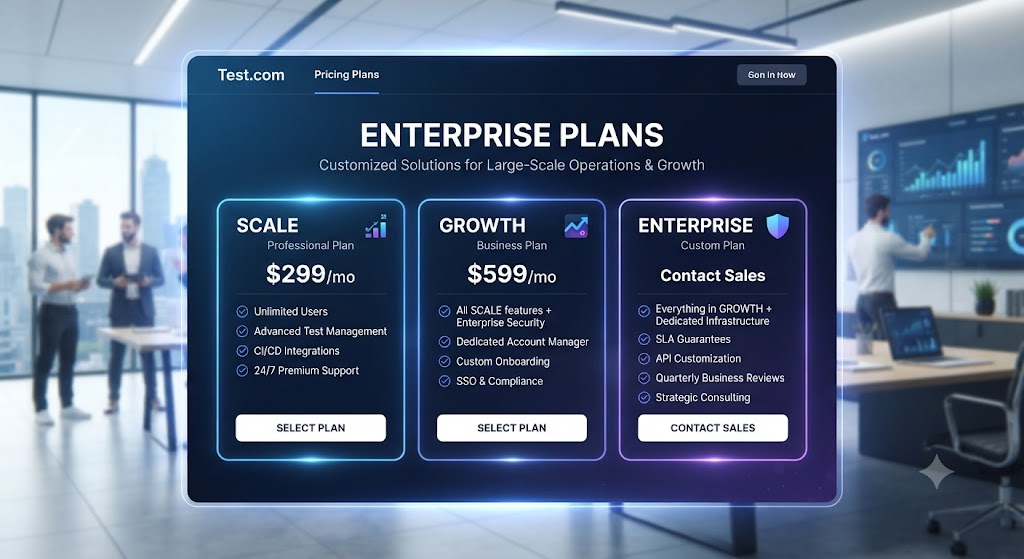
Comparison of Plan Tiers
Customization and Scalability at the Core
When moving toward enterprise-level services, the primary focus is on how well the platform scales alongside your specific growth trajectory. Standard tiers often include predefined limits on test execution minutes or seat counts, which can hinder the agility of large engineering departments. Enterprise plans move away from these rigid structures.
Instead, they offer bespoke arrangements tailored to the exact capacity your infrastructure requires. This might involve negotiated tiers for concurrent test sessions or flexible scaling models that adapt to your seasonal deployment cycles. By decoupling capacity from rigid pricing, large companies can avoid the friction of constantly needing to upgrade accounts. This approach allows engineering leads to focus on building quality software rather than managing subscription limits. Furthermore, these plans often provide access to infrastructure optimizations that are not available in lower tiers, such as specialized high-performance computing resources. The ability to scale vertically and horizontally ensures that whether you are running a single critical suite or thousands of tests simultaneously, the execution environment remains stable, performant, and reliable under high load.
Advanced Security and Compliance Measures
For large-scale organizations, security is not just a checkbox; it is a fundamental requirement. Enterprise-level testing platforms understand that protecting source code, sensitive test data, and user information is paramount. These plans prioritize security by offering features that exceed standard industry practices.
This typically includes mandatory Single Sign-On (SSO) integration, allowing companies to manage user access through their existing identity providers. This ensures that only authorized personnel can trigger tests or view sensitive reports. Additionally, enterprise tiers often provide granular role-based access control, ensuring that team members only have the permissions necessary for their specific functions. Compliance is another critical pillar, with many providers offering detailed audit logs and reports that track every action taken within the system. This level of oversight is essential for companies operating in regulated industries, such as finance or healthcare, where demonstrating compliance with data handling standards is mandatory. By moving to an enterprise tier, organizations gain the confidence that their testing environment is hardened against external threats while simultaneously providing the internal controls needed for robust governance and risk management.
Dedicated Support and Expert Guidance
Navigating the complexities of enterprise testing tools can sometimes lead to technical hurdles, especially when dealing with unique or legacy architectures. While self-service documentation is helpful for common issues, enterprise plans provide a significantly higher level of support to ensure minimal downtime and rapid issue resolution.
This often manifests as access to a dedicated account manager or a team of technical support engineers who understand the specificities of your implementation. Having a single point of contact who is familiar with your company’s unique setup, pain points, and strategic goals makes a massive difference in day-to-day operations. Instead of waiting in a general queue, enterprise customers benefit from prioritized response times and, in many cases, direct lines to experts who can assist with complex troubleshooting, architecture reviews, and best-practice guidance. This partnership model is designed to be proactive rather than reactive. By working closely with dedicated support, organizations can optimize their test suites faster, adopt new platform features more effectively, and ensure their entire testing ecosystem is aligned with industry-standard patterns, ultimately leading to greater ROI and improved developer productivity across the board.
Integration Into Complex DevOps Ecosystems
Enterprise-grade testing tools are rarely standalone solutions; they must fit perfectly into a sophisticated DevOps environment. Large organizations typically have highly customized CI/CD pipelines, various cloud providers, and internal tools that need to communicate seamlessly with their testing infrastructure.
Enterprise plans excel here by offering robust, well-documented APIs, webhooks, and pre-built plugins that facilitate deep integration. This enables teams to trigger tests automatically upon code commits, pass results back into their issue tracking systems, and generate reports that feed directly into business intelligence dashboards. The goal is to make the testing tool disappear into the workflow, becoming a background component that delivers insights without requiring manual intervention. When a platform offers comprehensive integration support, it removes the need for expensive custom middleware or glue code that teams often have to build to make incompatible systems talk to each other. By streamlining these connections, companies can accelerate their deployment velocity and ensure that quality is maintained consistently from the development phase all the way to production, reducing the risks associated with manual handoffs and fragmented toolchains.
Detailed Reporting and Analytics Capabilities
In large organizations, data-driven decision-making is essential. The ability to look at testing results and extract actionable intelligence determines the efficiency of the entire development organization. Standard reporting is often limited to “pass” or “fail” metrics, which are insufficient when managing hundreds of thousands of test executions.
Enterprise plans provide advanced reporting and deep analytics dashboards that offer a holistic view of quality health. This goes beyond simple status counts to include historical trend analysis, performance benchmarking across different browser or device combinations, and the ability to identify flaky tests that degrade pipeline trust. These analytics allow engineering leads to spot bottlenecks in the release process, correlate testing outcomes with specific code changes, and make informed decisions about resource allocation. Furthermore, enterprise-level reporting often allows for custom report generation, enabling teams to tailor the information provided to different stakeholders, from technical testers to non-technical project managers. This level of visibility transforms test reports from simple diagnostic tools into strategic assets, helping organizations continuously improve their software quality metrics and demonstrate the value of their testing initiatives to the wider business.
Flexibility in Deployment Options
One of the defining characteristics of enterprise-scale software is the need for deployment flexibility. While many organizations are happy to utilize cloud-based SaaS solutions, others have strict requirements regarding where data is stored, how infrastructure is accessed, or how traffic is routed to ensure compliance or minimize latency.
Enterprise plans address these varied needs by offering diverse deployment architectures. This may include the option to run tests in a dedicated, isolated cloud instance that provides higher performance and security compared to shared environments. For highly sensitive operations, some vendors offer on-premise or private cloud deployment options, allowing the organization to keep all testing data and infrastructure entirely behind their own firewall. This level of control is often a deal-breaker for large enterprises that must maintain absolute sovereignty over their data. By providing these options, the platform ensures that its services can meet the technical and architectural standards of any company, regardless of how restrictive their internal policies might be. This flexibility effectively removes a major barrier to adoption, allowing large-scale businesses to benefit from the platform’s features without needing to compromise their operational standards.
Frequently Asked Questions
What justifies the cost of moving to an enterprise tier? The investment is justified by the combination of dedicated support, higher capacity, advanced security features like SSO, and deeper integrations that reduce operational overhead and improve team productivity.
How is the pricing typically structured? Pricing is rarely one-size-fits-all and is usually negotiated based on projected usage volumes, required features, preferred deployment model, and the necessary level of dedicated support.
Can I switch from a Business plan to an Enterprise plan later? Yes, most providers make it easy to scale upward. As your team grows and your testing needs become more complex, transitioning allows you to unlock necessary advanced features and capacity.
Is custom security setup included in the base enterprise offer? Standard enterprise plans usually include advanced security features, but highly specific or complex custom security requirements may involve additional configuration, though they are much more achievable than on lower tiers.
Conclusion
Selecting the right subscription tier is a critical decision that influences the long-term success of your software delivery lifecycle. While lower-cost tiers are excellent for getting started or for smaller teams, enterprise plans provide the architectural stability, high-end security, and deep visibility required to support large-scale engineering organizations. By investing in these comprehensive solutions, companies gain more than just access to a tool; they gain a strategic partner capable of scaling with their unique demands.
The true value of these plans lies in the reduction of friction. When concurrent execution limits disappear, when security workflows align with corporate mandates, and when data analytics provide clear paths for improvement, teams can shift their focus from managing their tools to delivering high-quality user experiences. It is essential to conduct a thorough analysis of your current usage patterns, pain points, and future growth objectives before committing. Engage with providers to discuss your specific needs—don’t hesitate to ask about custom configurations. Ultimately, the best enterprise plan is one that feels invisible, working seamlessly to empower your developers, accelerate your release cycles, and provide the insights necessary for continuous improvement. By making an informed choice now, you set the foundation for sustainable software quality as your organization continues to expand.